A device can look unbeatable on a quotation: a huge puff count, a long flavor list, a bright screen and a low unit price. None of that tells a retailer whether it will sell through, come back as a complaint or sit on the shelf until the next promotion.
That is the real job of wholesale buying. You are not choosing the most impressive specification sheet. You are choosing a product that fits your customers, your price ladder, your local rules and the level of after-sales work your team can handle. This guide looks at the decisions behind that choice, with particular attention to high-puff rechargeable devices. It is written for vape shops, online retailers, wholesalers and distributors buying for adult-only markets.
Start with the shelf, not the biggest number
Before comparing models, decide what job the new product needs to do in your range. Is it an entry-price item that brings people into the shop? A mid-tier everyday device? A higher-priced multi-flavor option? Or a long-use format for customers who dislike replacing devices frequently?
That answer immediately narrows the field. A compact single-flavor model and a large multi-flavor device may both appear in a supplier’s disposable vape range, but they do not compete for the same shelf space or the same customer. Treating them as interchangeable usually leads to a confused assortment: too many similar flavors at one price, gaps at another, and no clear reason for a customer to trade up.
Look at the price bands with steady turnover, the flavor families that generate repeat purchases and the questions customers ask before buying. Questions about charging, battery indication or switching flavors reveal which features need to be obvious at the counter, not merely present in a technical description.
Puff count is a positioning signal, not a promise
High puff figures attract attention, so it is tempting to compare devices by dividing the wholesale price by the advertised number. The calculation looks precise. The result is not.
Puff counts are normally manufacturer-rated estimates. Actual use varies with draw length, frequency, airflow, power settings, coil behavior and how the device manages its remaining liquid and battery. Two people can use the same model and report very different lifespans. For that reason, product pages and staff training should use language such as “up to” or “manufacturer-rated,” rather than turning a laboratory or supplier estimate into a guarantee.
The figure still has value. It tells you how a device is positioned and what sort of use cycle the manufacturer intends. A 300K-puff collection, for example, belongs in a different conversation from a smaller low-cost disposable. The mistake is assuming that the larger number automatically creates better value.
Ask what supports the claim. How much e-liquid is specified? Is the battery rechargeable? What coil arrangement is used? Does the screen help the user manage the device? Are there multiple flavors or operating modes that affect consumption? A believable product story is built from specifications that make sense together. If one headline number overwhelms every other detail, more questions are needed before a purchase order is signed.
Rechargeability changes the standard customers apply
Once a disposable is designed to be recharged, customers judge it less like a short-life item and more like a piece of hardware. They notice the charging port, screen, body strength and consistency over time. Expectations rise with the retail price.
Start with the basics. Confirm the charging connector, stated battery capacity, charging guidance and any cable policy. Type-C is familiar to many buyers, but the connector alone does not tell you how quickly or reliably a device charges. Supplier instructions should be clear enough for your product page and customer-service team to repeat without guessing.
Then consider the full use cycle. The battery, coil system and liquid capacity need to remain useful together. A large reservoir is not much comfort if flavor quality declines early, and a capable battery is not enough if the user cannot tell when to charge it. The strongest cigarette électronique jetable rechargeable proposition is a coherent product experience, not simply the presence of a charging port.
If samples are available, have several adult evaluators follow the supplied instructions and record the same points: setup, draw consistency, screen readability, charging behavior and any leakage or unusual heat. A consistent checklist is more useful than vague reactions such as “good flavor,” even though it is not a laboratory test.
Flavor architecture can matter more than flavor count
A long menu looks reassuring because it seems to reduce the chance of missing a popular taste. In practice, too many near-duplicates can split demand and create slow stock. “More flavors” is not the same as a better opening order.
Think in flavor families first: fruit, ice, beverage, mint or menthol, candy and tobacco-style options where permitted and relevant. Your exact mix should come from local sales, not a universal top-ten list. Climate, customer habits and even store location can change what moves. A fruit-heavy range may work in one account while another needs a stronger mint or beverage presence.
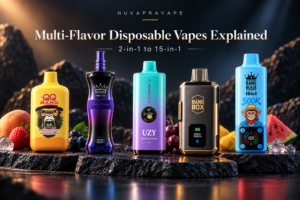
Multi-flavor devices can justify a higher ticket and offer variety without several separate units. They also need a simple switching method. If staff require a long demonstration, the feature may become friction rather than value. Confirm how flavors are selected, how the liquid and coil arrangement works, and what the screen actually shows.
One current example is the UZY 10-in-1 500K Puffs Disposable Vape. According to the listed specifications, it combines ten flavors, 64 mL of prefilled e-liquid, a 650 mAh rechargeable battery, Type-C charging, a five-coil 0.5-ohm mesh system and a smart screen, with a manufacturer-rated output of up to 500,000 puffs. Those details make it a useful comparison point for a high-capacity, multi-flavor format. They do not replace market testing: the real buying question is whether your customers understand the format and accept its price.
Translate coils and screens into customer value
Technical terms often fill wholesale listings because they make products sound differentiated. A retailer needs to know what each feature changes in daily use.
Mesh coils, dual-mesh arrangements and multi-coil systems are generally presented as ways to improve heating coverage, vapor production or flavor consistency. Do not stop at the label. Ask which coils are active at a given time, whether the device changes between them and whether any mode alters consumption. If a supplier cannot explain the system plainly, your staff will struggle to explain it at the counter.
Screens deserve the same scrutiny. Battery level is practical because it helps a customer decide when to recharge. E-liquid indication may reduce uncertainty if the reading is reasonably clear. Mode information can be helpful on a device with selectable settings. A decorative animation may catch the eye but does little to prevent misuse or complaints. Confirm every displayed indicator before describing it online; never infer a puff counter, liquid gauge or power mode from the presence of a screen alone.
Buttons, switching actions and multiple indicators need accurate instructions. Ask for a manual, clear product images and a short operating video before launch; they can save considerable support time.
Build a first order that can teach you something
The opening order should show real demand while letting you see what caused the result. If every model, format and flavor changes at once, a good or bad sales week tells you very little.
A trial might keep the hardware consistent while varying a few flavor families, or compare one familiar single-flavor line with one multi-flavor line at a similar price. Change a few meaningful variables, not everything.
Avoid giving every SKU equal depth by default. Put more units behind flavors with evidence from your own sales data, a smaller quantity behind adjacent choices and very little behind genuinely experimental options. Reorder speed matters here. A supplier with stable availability may allow a leaner first order than one with long production or shipping lead times.
Set a review date before the stock arrives. Track sell-through, margin, repeat requests, returns and common questions. Fast sales paired with disproportionate complaints may be less valuable than a slightly slower line with clean repeat business. Support time, replacements and dead stock belong in the calculation too.
Nicotine options and destination rules come before packaging
Nicotine strength is both a commercial choice and a compliance issue. A supplier may list several concentrations, but availability does not mean every option can be sold in every destination. Confirm the exact variant, labeling, warnings, packaging and documentation required for each market before ordering or advertising it.
In the United States, the FDA’s information on electronic nicotine delivery systems is a starting point for federal requirements and product status. Retailers should also check applicable state and local rules. In the European Union, the European Commission’s e-cigarette regulation overview explains the EU framework, while individual countries may add notification, tax, flavor, packaging or retail requirements.
Copying a competitor’s listing is risky: their product may be a different version, intended for another country or published before a rule changed. Ask for the destination-specific SKU and current supporting documents. Verify claims affecting legality, tax or safety with the relevant authority or a qualified local adviser.
Keep age restrictions visible, avoid health or cessation claims, and make sure the listing is appropriate for an adult audience. Careless marketing can create problems around an otherwise compliant product.
Evaluate the supplier behind the device
Product selection gets most of the attention, yet supplier performance often decides whether a line remains profitable. A sharp sample and an attractive price are only the beginning.
Confirm who handles manufacturing, export documents, shipping terms and post-sale issues. Ask for a current specification sheet, packaging artwork, nicotine details, ingredient or test documentation where applicable, carton quantities, lead time and warranty or defect policy. The answers should refer to the exact SKU you are buying, not a similar model from an old catalogue.
The quotation, invoice, packaging, product page and compliance files should agree on model name, capacity, nicotine strength and destination version. Resolve discrepancies in writing before payment. For a customized order, production photos or video can help confirm packaging and labeling.
A reliable supplier will distinguish confirmed specifications from estimates and say when something requires checking. Fast answers are convenient; accurate answers are more valuable. The supplier should help your team publish correct information and resolve the occasional problem without turning every case into a negotiation.
Questions to ask before sending the purchase order
Keep the final check short enough that your buyer will actually use it. For each SKU, confirm:
- the manufacturer-rated puff count and the conditions or design features behind it;
- e-liquid capacity, battery capacity, charging type and coil configuration;
- available flavors and nicotine strengths for the intended destination;
- what the screen, buttons or switching mechanism actually do;
- packaging, warnings, age restrictions and market-specific documents;
- sample availability, minimum order quantity, lead time and shipping terms;
- the process for shortages, visible damage, defects and replacements.
Save the supplier’s replies with the order. They become the reference for your product listing, staff briefing and any after-sales discussion. If a key answer remains vague, reduce the trial quantity or wait. Urgency is rarely a good reason to buy a product your team cannot describe accurately.
Frequently asked questions
Are higher puff counts always better for retailers?
No. A higher manufacturer-rated count can support a higher retail price and a longer-use proposition, but it also raises customer expectations. The device still needs a suitable battery, coil system, liquid capacity and clear instructions. Judge the complete format and likely sell-through, not the headline number by itself.
How many flavors should a retailer order first?
There is no fixed number. Start with flavor families already supported by your sales data, then add a small number of adjacent or experimental choices. A focused range is easier to explain and produces cleaner sales data than a wide selection of similar flavors.
Should a buyer request samples before a wholesale order?
For a new device or supplier, request samples when available and evaluate them against the same checklist. Samples cannot represent every production unit, so also confirm documentation and the defect policy.
What should a smart screen show?
Only describe functions the exact model is confirmed to provide. Battery indication is common and practical; some devices may also show liquid level, mode or other status information. Do not assume those features from a product photo or from the word “smart.”
How should retailers compare wholesale prices?
Compare expected margin alongside freight, duties, taxes, payment terms, lead time, sell-through, return risk and after-sales workload. A slightly lower unit price can be expensive if stock moves slowly or documentation is incomplete.
A better first order is a better starting point
The best wholesale decision is not the device with the loudest box. It is the one your team can position clearly, document correctly and reorder with confidence. Begin with the customer and price band, treat puff count as an estimate, test the logic of the hardware, and keep the first assortment focused enough to learn from.
Nuvapra supplies a broad range of high-puff and rechargeable disposable formats for wholesale buyers. To discuss destination, product mix, minimum order quantities or current specifications, contact the Nuvapra team with your target market and preferred format.
For adult trade customers only. Products containing nicotine are addictive. Regulations vary by country and may change; buyers are responsible for confirming the requirements that apply in each destination.